Safety first. Wear eye protection and gloves. Keep sparks, flames and cigarettes away: lead-acid batteries can release hydrogen gas. Disconnect the negative (-) terminal first and reconnect it last. Never work on hybrid or EV high-voltage batteries. Follow your owner’s manual.
A multimeter test takes five minutes and tells you whether you need to spend money on a new battery. Enter your readings in our voltage checker for a plain-language verdict, or follow the thresholds below.
What you will need
- A digital multimeter.
- Gloves and eye protection.
- A helper for the cranking test.
Steps
-
Resting voltage. With the car off for 12 hours or more, set the meter to 20V DC. Touch red to the positive (+) terminal and black to negative (-).
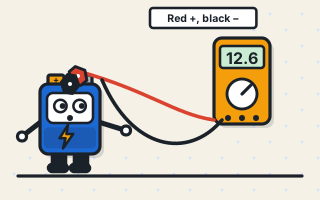 A rested flooded battery at about 12.6V or more is fully charged; around 12.0V is roughly 25% charged.
-
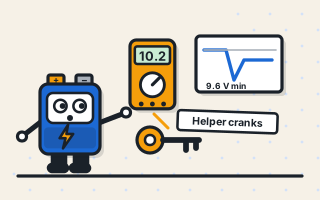
Cranking voltage. Ask a helper to start the car while you watch the meter. It should stay above about 9.6V.
-
Charging voltage. With the engine running, expect about 13.7V to 14.7V. Smart alternators can vary.
These thresholds are starting points we are verifying with battery maker guides, and we do not give percentages in between until they are sourced.
Reading the result
- Low at rest: charge it, then retest.
- Low while cranking: clean the terminals, charge and retest, then consider replacement.
- Off while running: see dead battery or alternator?.
If you need a new battery, the cost calculator shows what to expect.
FAQs
Can I test with the battery in the car? Yes.
Do AGM batteries read differently? Their resting bands differ and we are still checking them, so confirm with the maker’s guide.
Before you test
Make sure the car has been off for a while. A battery that has just been charged or driven shows a surface charge that reads higher than its true state. The most reliable resting test is after the car has stood for several hours or overnight. Park somewhere safe, switch off all lights and accessories, and lift the bonnet.
Choosing a multimeter
Any basic digital multimeter with a DC voltage range up to 20V is fine. Check that the probes are in good condition and that the meter’s battery is not flat; a weak meter battery can give odd readings. Clip-on probes are helpful for the cranking test because you can hold them in place while someone starts the car.
Doing the resting test step by step
- Wear eye protection and gloves.
- Set the meter to DC volts, 20V range.
- Touch the red probe to the positive (+) terminal and the black probe to the negative (-). Make sure the probes touch clean metal, not corrosion.
- Read the display and write it down.
OPTIMA Batteries states that fully charged starting batteries read about 12.6V to 12.8V with the engine off, that you should charge a battery that falls below about 12.4V, and that a healthy battery should not rest below about 12V. Our voltage checker applies those bands.
The cranking test
Ask a helper to turn the key while you watch the meter. The voltage will dip. Our starting threshold is about 9.6V; if it drops far below that, the battery may be weak or the connections poor. We are still verifying this threshold, so treat it as a guide and confirm with a professional load test if in doubt.
The charging test
With the engine running at a fast idle, measure again. A typical charging range is about 13.7V to 14.7V. Some modern cars use smart alternators that vary the voltage, so a reading outside that range is a reason to check further, not proof of a fault. See dead battery or alternator?.
What a multimeter cannot tell you
Voltage shows state of charge, not capacity. A tired battery can show 12.6V at rest and still fail under load. A load test, which many parts stores offer for free, measures how well the battery delivers current. If your battery is over three years old or shows slow cranking, have it load tested even if the voltage looks fine. AAA puts typical battery life at roughly three to five years: see how long car batteries last.
What to do with the result
- Good resting and cranking voltage, normal charging: the battery is probably fine. Look for other causes, such as corrosion, a parasitic drain or a starter issue.
- Low resting voltage: charge fully and retest. Our charging time calculator estimates how long.
- Poor cranking voltage: clean the terminals, charge, and retest. If it still fails, replace.
- Poor charging voltage: have the alternator and belt checked.